The Betta Starter Guide I Wish I Had
When I was a teenager, I won a fish. I wasn’t trying to win a fish, I was trying to win a stuffed animal at a local carnival. But I landed all of those bouncy ping-pong balls into the cups (my specialty) and they handed me a cup with a pretty blue fish in it.
I took it home and told my dad we needed to go to the pet store and get supplies.
Side note: Fish should NOT be given as prizes at carnivals. But that’s a whole other discussion for another time.
I had no idea what I was doing, but I liked my new little buddy. We told the store employee that I won a betta fish and needed an initial setup. He was helpful, telling us the basic items we’d need and how to make sure the water was safe for the fish. We left with our supplies and set up the fish tank. The problem? It was one of those betta cubes, with 2.5 gallons of water.
Looking back, I feel horrible that I put the fish in there. But I was a teenager, and I did what the store employee in the fish department told us. I had no idea it was so wrong.
But as I looked at my fish on my bookshelf, I started to wonder…How happy can he be in there? And that started my research into betta fish.
Fast forward to 2026. I really wanted a betta again, and I was ready to give one the life it deserves. This is George, and he loves his setup. (I’ve since added another betta, in a separate tank, named Cooper.)
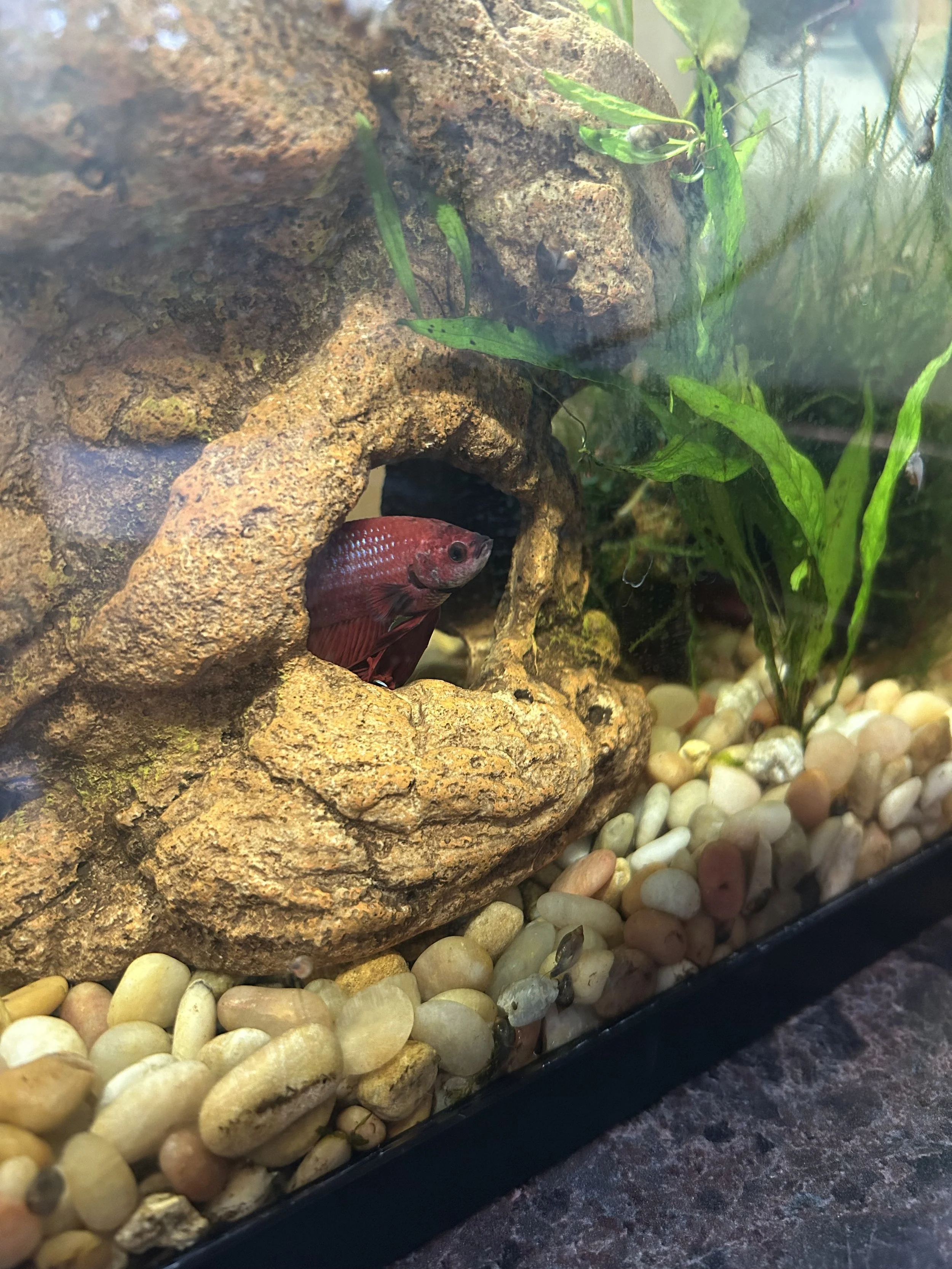
So if you’re ready to get a betta fish, or you just want to upgrade your current betta’s setup, I’m here to help.
Before we dive in, I’m not a fish expert. But I have learned a ton about their care and keeping in getting my tanks set up. I’ve also dealt with a couple of health and water issues and kept all of my fish healthy and alive. So while I always recommend talking to experts wherever you can, and continuing to learn as you go, here’s everything I personally recommend for your new (or upgraded) betta setup.
The Tank
The minimum size I would get for a betta fish is a 5-gallon aquarium. I personally like 10-gallon aquariums, because they allow for more variety in your hardscaping (more on that later) and even some tank mates.
I have one betta, George, in a 10-gallon tank with neon tetras and shrimp, and another betta, Cooper, in a 5-gallon aquarium on his own. Cooper has a heavier tail and doesn’t have tank mates, so the 5-gallon aquarium works well for him.
🐟 Key takeaways & PRECAUTIONS
A 5-gallon aquarium is the smallest I recommend that you go, but a 10-gallon gives your betta even more room to explore and can offer more options if you’re considering compatible tank mates
Choose a long tank over a tall or vertical one — bettas prefer horizontal swimming space, and since their labyrinth organ allows them to breathe air from the surface, a shallower tank also makes it easier for them to pop up for a breath
Never put your betta in a bowl, vase, or other very small container
⭐️ MY TOP TANK PICK
There are so many great tanks out there, but I really like the Top Fin® Essentials Aquarium Starter Kit. I was skeptical, because it doesn’t have the greatest reviews.
But I gave it a try, and it’s what I have for both of my bettas. I’m not even an affiliate for this one, it’s just a nice, simple tank that works well. Note that the 5-gallon tank does not come with a thermometer, so that will have to be purchased separately.
the Tank Essentials
There are also some things that your tank will need.
Heater: Some people say that bettas don’t need heaters. Technically, your betta can survive without one. But they are tropical fish that need temperatures between 76°F and 82°F to be happy and healthy. Please don’t skip the heater. Make sure to get an aquarium thermometer as well to keep an eye on the water temperature.
Filter: Your tank will also need a good filtration system. I highly recommend a sponge filter rather than a cartridge filter. It provides better filtration and lasts a long time. It’s also cheaper, because you won’t have to keep replacing the cartridge, but can rinse and squeeze out the sponge filter. (The tank kits I mentioned above come with cartridge filters, but I just swapped the cartridges out for sponges and they work great.)
Lid: Make sure your aquarium has a lid — bettas can be quite the jumpers!
🐟 KEY TAKEAWAYS & PRECAUTIONS
Your betta needs water between 76°F and 82°F
Use a tank thermometer in the water to keep an eye on the temperature
Get a sponge filtration system for your aquarium
Make sure your tank has a lid so your betta can’t jump out
Keep your filter on a low setting — bettas aren’t the best swimmers and can get caught up in the current of a strong filter
If your betta seems to be getting stuck to your filter, secure some filter sponge at the bottom of the intake tube to create a buffer
⭐️ MY TOP PICKS
The heater and filter that come with the tank kits I mentioned above will work great, but if you’re not using a kit, I really like the Hygger heaters and the Fluval filters.
The hardscaping
Your hardscaping is made up of the materials and decorations in your tank. Some people have incredibly beautiful hardscaping that I’m really jealous of, but you can keep it pretty simple. Here’s what to keep in mind:
Substrate: This is the sand or gravel at the bottom of the tank. Use a smoother gravel that won’t hurt your betta’s fins.
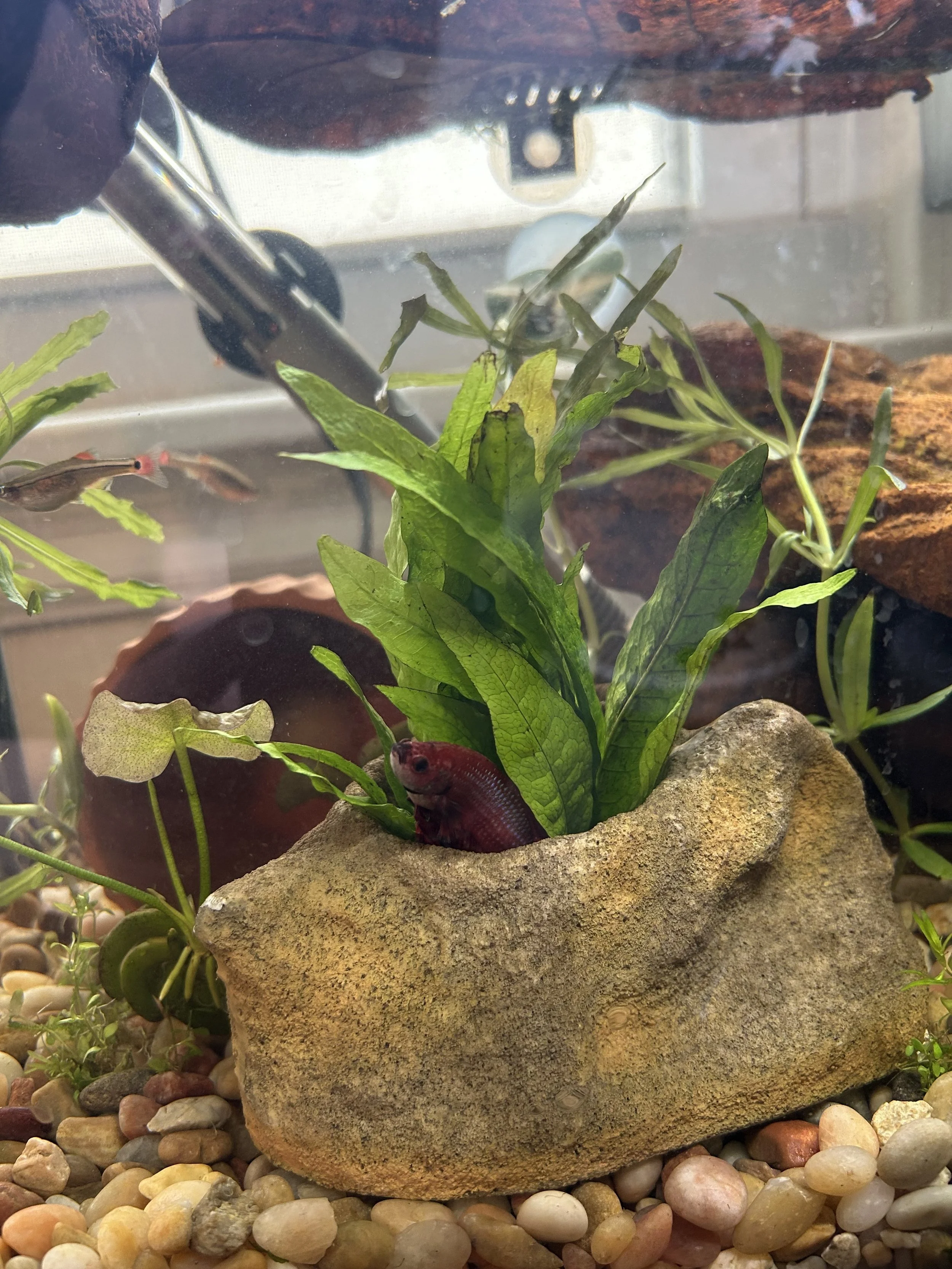
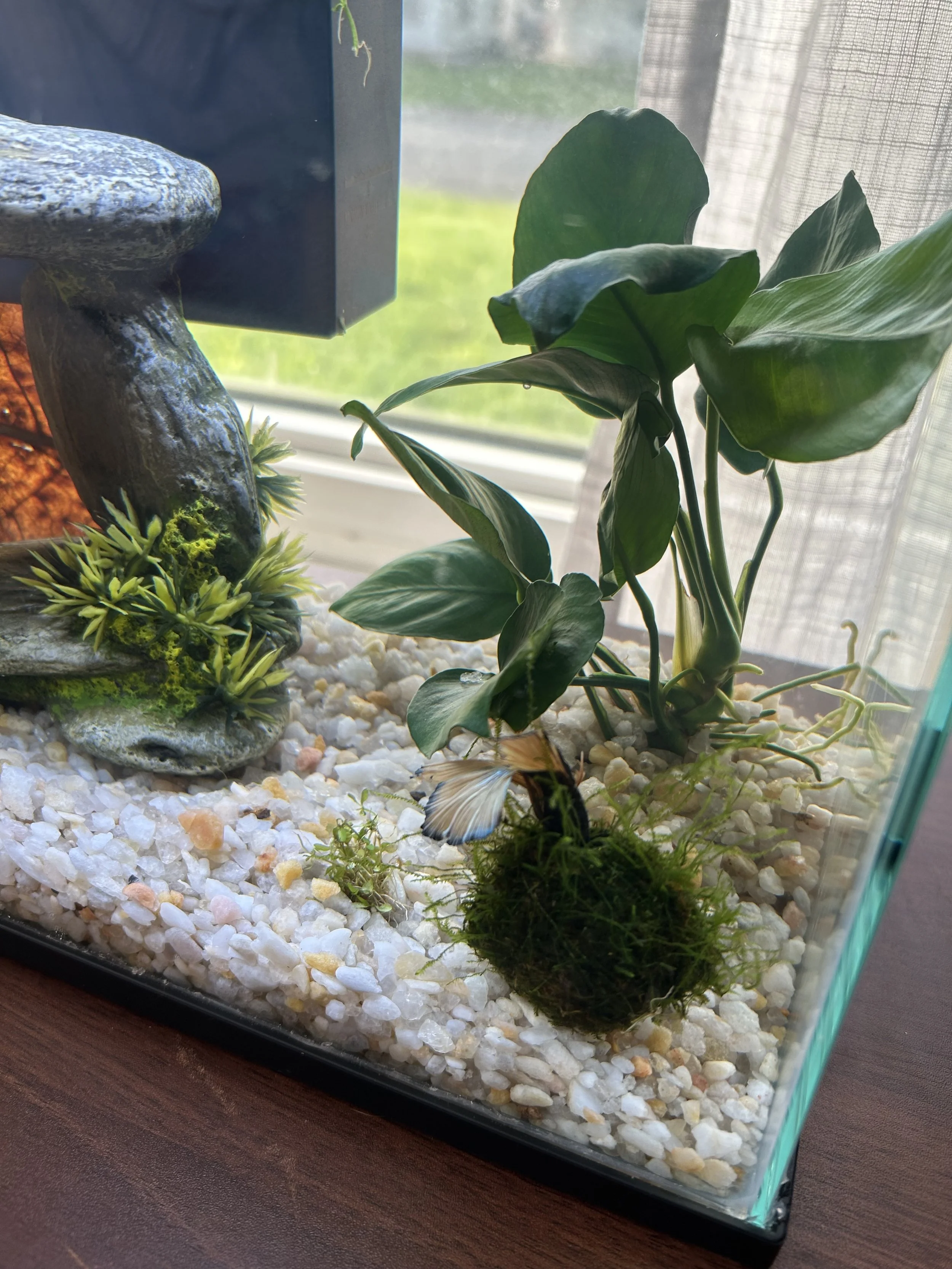
Plants: I always recommend having live plants in your aquarium. Bettas love to hide in them and they benefit the water quality. I have Java fern, Java moss, Amazon sword, Anubias, and an Octopus plant in my tanks. I did end up getting snails from live plants, which can happen. But they’re a fun little addition to my tank that do no harm.
Hides: Bettas like to retreat to their own private places. Give them caves, logs, or other hiding spots. I have a variety of hides: moss-covered domes, logs, and even small terra cotta plant pots.
Resting Surfaces: Bettas use their gills in the water, but like I mentioned above, they also have a labyrinth organ that allows them to breathe oxygen from the air. Because of this, they like to hang out near the surface of the water. My bettas love floating logs, hammocks, and leaves.
🐟 KEY TAKEAWAYS & PRECAUTIONS
Your betta needs plenty of elements in its tank — they like to have plants and hides to retreat to
Bettas have very sensitive fins that can easily tear, so make sure there are no sharp edges on the decor
Bettas will sometimes go into spaces that are too small for them, so make sure your decorations are spaced enough to avoid any cramped paths, and plug any holes that are too small for the betta to fit through (I use filter sponge for this)
⭐️ MY TOP PICKS
I use a substrate very similar to this one that I buy locally
I purchase my live plants from Aquarium Co-Op
My bettas love this log, these Catappa leaves(mounted to the side of the aquarium with this), and this floating cave
The Water
This is the most important element of your tank setup. Your water needs to be conditioned and cycled before you add your fish. I know it’s hard to set up the aquarium and leave it empty while you wait, but it’s a must for the safety and comfort of your fish.
Note: I realize that this may not always be possible. Like when I won that betta fish, I already had the fish and had to get it in a tank. Sometimes, people are gifted betta fish and need to do the same. I’ll share a few tips on how to do that as safely as you can, but always get the tank and water established before adding fish if you can.
First, you’ll condition the water: Fill your tank with tap water and use a water conditioner to make it safe for fish.
Then it’s time to cycle your tank. Cycling your aquarium means giving beneficial bacteria time to grow before adding your fish. These bacteria help process your betta’s waste by converting toxic ammonia into nitrite and then into the much safer nitrate. A properly cycled tank helps keep the water stable and prevents dangerous ammonia and nitrite spikes.
So to cycle the tank, you need to get it set up and add an ammonia source so the beneficial bacteria can begin to grow. You can purchase ammonia made specifically for cycling aquariums, but I just use fish food! Sprinkle a small amount into the tank like you’re feeding a fish, and as it breaks down, it will produce the ammonia needed to get the cycle started.
I know this sounds complicated, but it’s easier than it sounds, especially when you test your water. Get a testing kit that measures things like pH, nitrites, nitrates, and ammonia so you can keep an eye on water quality.
What about if you don’t have time to cycle the tank? This is called fish-in cycling, and it can definitely be done. Like I said, I did it with my first betta, and I’ve helped friends do fish-in cycling as well — and I’ve never lost a patient. 🙂
If you can, grab some established filter media from a healthy, cycled aquarium and add it to your new filter. Maybe you have a friend with an established tank, or your local fish store is willing to give you some used filter media. This media already has beneficial bacteria, so adding it to your filter can give your new tank’s cycle a big head start.
If you don’t have access to established filter media and your fish is already in the tank, you’ll just need to keep a close eye on the water while the beneficial bacteria become established. Condition any new tap water (I use and highly recommend Seachem Prime), test the water daily for ammonia and nitrite, and perform partial water changes whenever either becomes detectable. The goal is to keep ammonia and nitrite as close to 0 ppm as possible while the tank cycles.
But remember, a fish-in cycle can be hard on (and lethal to) fish, so only do it if absolutely necessary.
When it’s finally time to add your betta, don’t put them straight into the tank. Float the cup or bag they came in at the surface of the aquarium for about 15–20 minutes first. This allows the temperature inside their container to gradually match the temperature of the tank and helps reduce the stress of the move. Afterward, gently transfer your betta into the aquarium with a fish net rather than dumping the pet store water into your tank.
🐟 KEY TAKEAWAYS & pRECAUTIONS
Always condition new water (including when doing water changes)
Cycle your tank before adding fish, or if you must do a fish-in cycle, keep a very close eye on your water parameters
Test your water to maintain safe ammonia, nitrite, and nitrate levels for your fish
Float the betta in its cup or bag in your aquarium to let them acclimate to the temperature before adding them to your tank (and transfer them with a fish net rather than dumping the pet store water into your tank)
⭐️ MY TOP PICKS
Seachem Prime is, in my opinion, the best water conditioner on the market
The API Freshwater Master Test Kit will give you accurate reads on your water’s parameters (the strips are less accurate in my experience)
Any simple fish net like this will work for transferring your betta
the tank mates
Bettas don’t need tank mates, but if you have enough space, you may be able to add some compatible friends! Snails and shrimp can be good options, although some bettas may eat them.
Certain small, peaceful fish can also live with bettas in appropriately sized tanks, but I’d recommend researching each species’ space and group-size requirements before adding them.
My betta George lives happily with 7 neon tetras (a schooling fish that likes to be in bigger groups) and 4 Amano shrimp. Cooper, however, would likely not do well with tank mates, as he sometimes gets mad at his own reflection.
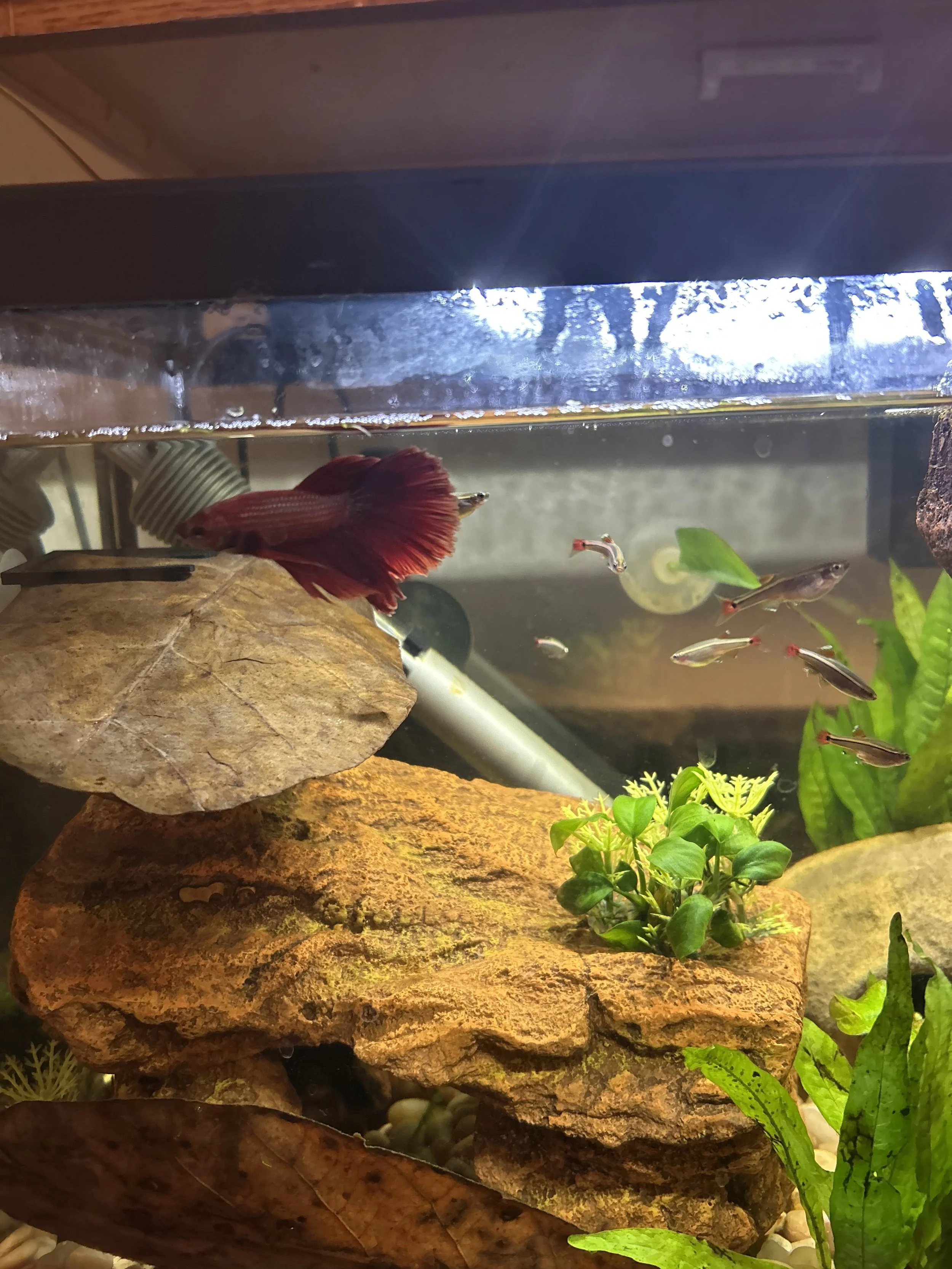
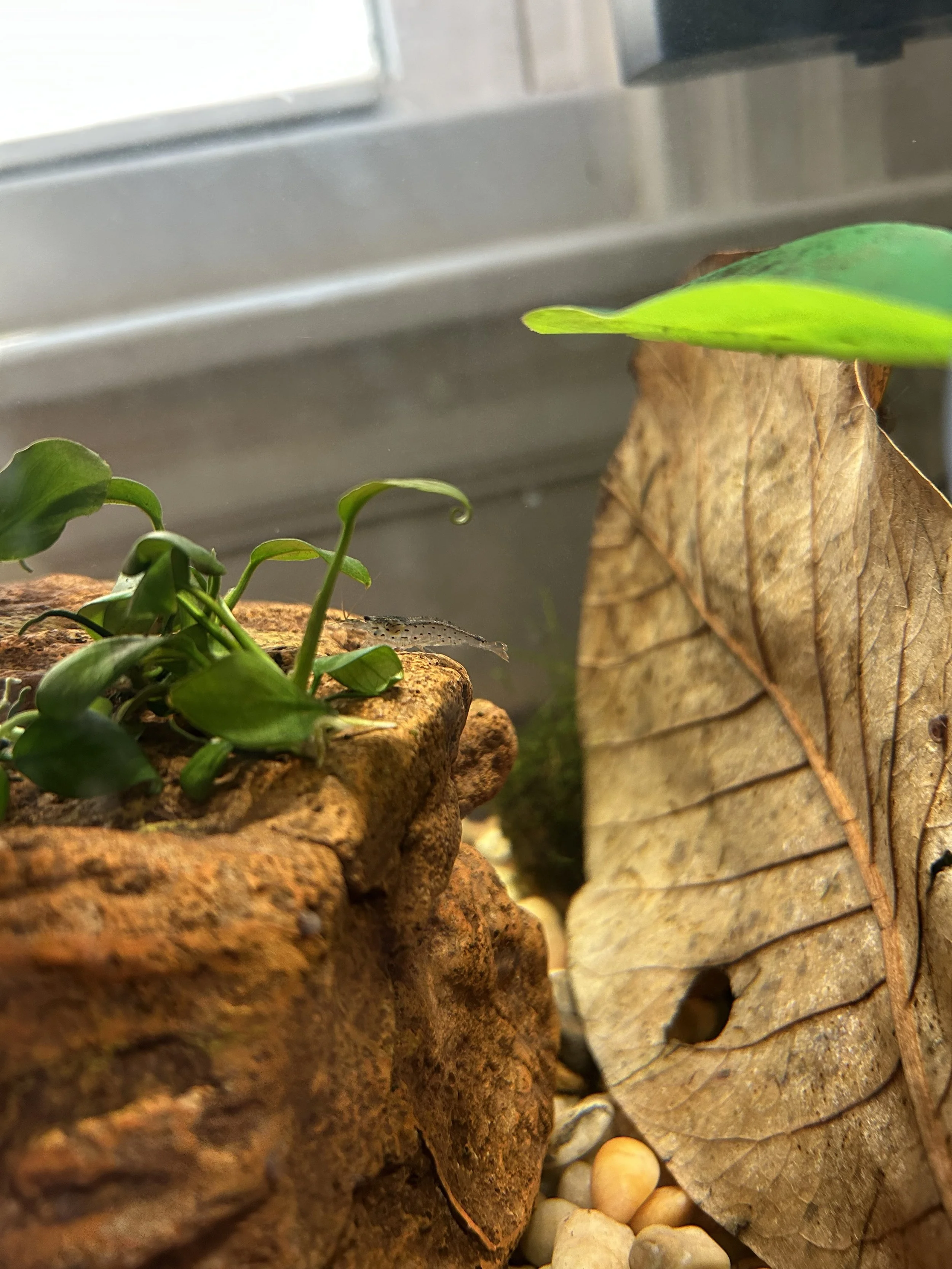
Every betta has a different personality. Some (like George) couldn’t care less about their neighbors, while others want the entire aquarium to themselves. Always have a backup plan in case your betta decides they’re not interested in having roommates. 😬
You’ll want to avoid overstocking your aquarium as well, so look up the requirements of each species before adding any tank mates. Mine is about as stocked as it can be (and some people may even consider it a bit overstocked), but I’m a meticulous tank maintainer and keep a close eye on my water parameters.
the Maintenance
Now that your tank is set up, let’s talk about maintaining it! The maintenance is much simpler than the setup, don’t worry.
DAILY TASKS
Simply check on your fish and aquarium. Make sure none have died and that they’re all behaving normally.
Make sure your filter and heater are on and running. I like to keep an eye on the water level in my filter. Once, it got a little jammed up with muck and ended up spilling all over the floor. Now I watch it like a hawk!
Check the temperature of your water. I have never had a heater malfunction, but it can happen, so you want to make sure it’s not too cold or too hot.
Feed your fish following the guidelines on the package. Be careful not to overfeed, because fish can overeat, or if they don’t eat it all, excess food will decompose and turn into ammonia in the water.
WEEKLY TASKS
Test your water. You can do this more often if your tank is new or your fish are behaving differently. Anytime I notice a fish not acting quite right, I always test the water right away.
Do a partial water change. Remove about 25% of your water and replace it with fresh water. When adding new tap water, always add the appropriate amount of water conditioner as well. You can find that amount on the water conditioner packaging.
Clean the tank and decorations as needed. Scrape algae off the sides, remove any uneaten food, and vacuum any dirty gravel. If you’re cleaning off the decorations, always do that in tank water and not tap water.
⭐️ MY TOP PICKS
Use a hose like this for water changes
Give your betta healthy food — mine love this (and freeze-dried bloodworms for a treat)
TROUBLESHOOTING
I have run into a few problems in my aquariums, and I want to help you avoid the same ones — or at least know what to do if they come up!
Torn Fins: I once noticed pieces missing from George’s tail. There were two different types of damage, and I figured out both causes by watching the tank for a while.
George was getting stuck up against the intake tube of the filter and it was tearing his fins. I secured a bit of filter sponge around the intake tube and it solved the problem.
Then I realized why there was an entire chunk missing out of his fin. The tetras were nipping at it. 😑 So I rescaped the tank to have better zones. I made sure there was a higher decoration in the middle that separated the two sides, added more plants and caves for George to hide in, and made sure the tetras had plenty of swimming space to keep occupied. Problem solved, and George’s tail grew back.
Ammonia / Nitrite Spike: This is such a scary thing, because it can be fatal for your fish. I underfed for a few days, did a larger dose of Prime (according to its directions), and did daily partial water changes until it was under control. The fish never showed signs of stress, unlike I did — I had a hard time sleeping during that spike!
Sickness / Broken Equipment: I like to keep a few things on hand in case of an emergency. I have a 3-gallon tank that I can use as a hospital tank, treatments for common betta diseases, and an extra heater in case one dies.
Basically, if something might be urgent (like sickness or suddenly not having heat), I keep what I might need on hand.
I hope this helps you with your new or current betta. They’re such fun pets to have and watch. Wishing you and your finned friend the best!
📌 SAVE THIS FOR LATER
Hover your cursor over the image and Pin this to your Pinterest account by clicking the red ‘Save’ button.